
How am I doing?
By others' standards.

They say it’s good to be vulnerable.
They say it’s healthy to be truly seen.
However, we tend to avoid being vulnerable or asking for honest feedback regarding our ministry. When it comes to the work you do, there are so many layers and behind the scenes, blood, sweat, and tears that should receive way more credit than just what is seen from the outside or at the finish line.
This particular time, it was one of the most encouraging exercises as the church staff dissected the effectiveness of each ministry, including the one I was leading, First Impressions, or (Guest Services, for most churches).
It was our usual staff meeting. We walked into the room and discovered large blank Post-it posters on every wall. Each one had a ministry written at the top, with Strengths on the left and Weaknesses on the right.
The instructions were simple.
Write on other ministries’ posters and provide honest, loving feedback. No prep. No heads up before the meeting.
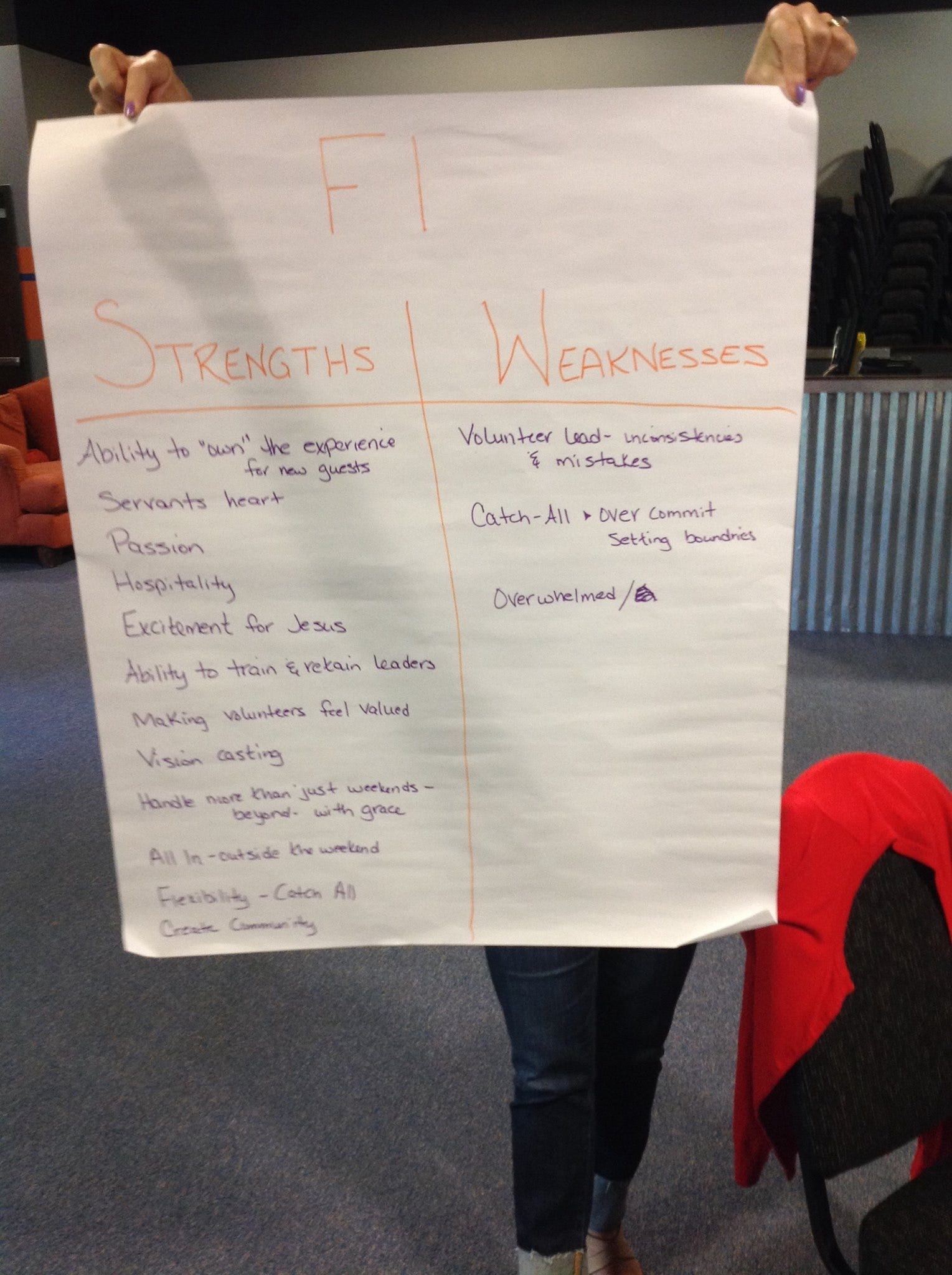
The list on mine:
Strengths
Ability to “own” the experience for new guests.
Servant’s heart.
Passion.
Hospitality.
Excitement for Jesus.
Ability to train and retain leaders.
Making volunteers feel valued.
Vision Casting.
Handle more than just the weekends - beyond - with grace.
All in, outside of the weekends.
Flexibility, catch all.
Creative Community.
Weaknesses
Volunteer leaders - inconsistencies and mistakes.
Catch all - overcommit, setting boundaries.
Overwhelmed.
And yes, that is me, back in 2013, holding the results.
My team was proud of the strengths, but the power was in our weaknesses.
Sure, I could defend each one.
Of course, volunteers make mistakes.
It’s difficult to set boundaries when the job calls for volunteers to participate in all things.
And, yes, it can be overwhelming.
But if others saw these issues as a weakness in our ministry, then we needed to dig in and see how we could shore up the areas that perhaps we took for granted or were harboring a blind spot. Because left unattended, this is where the slide toward complacency can gain ground.
Here is one of the most important lessons I learned. Never do ministry in a vacuum.
Bring in your key leaders or volunteers early in the process. When they get to wrestle with ministry issues, brainstorm ideas, and develop solutions, they not only help implement changes, but they are also willing to be accountable for its success.
The list below is the result of such a discussion on a Saturday morning.
Volunteer Leader Inconsistencies:
Set up regular, meaningful meetings where leaders drive the agenda. The volunteer leaders were frustrated and didn’t know how or if they could speak about the changes happening every weekend. We need a simple, clear process that would span all weekends, regardless of who was serving. As one leader shared, “I want to learn from other leaders, and reading how they handled a situation makes me a better leader.”
Catch all - overcommit, setting boundaries:
We brainstormed building new teams with new serving rhythms. I shared the plan with each ministry staff, asking what they require to support their volunteer needs with a healthy timeline and capacity. It was a great exercise in breaking down walls between ministries and looking for ways to support one another.
While we were not expecting feedback on our weaknesses, it certainly paved the way for the team I led to grow and get better.
Life, and especially life as a Christ follower, requires growth. God loves us too much to have us remain the same. The same holds for the ministry you lead.
So, how are you doing?